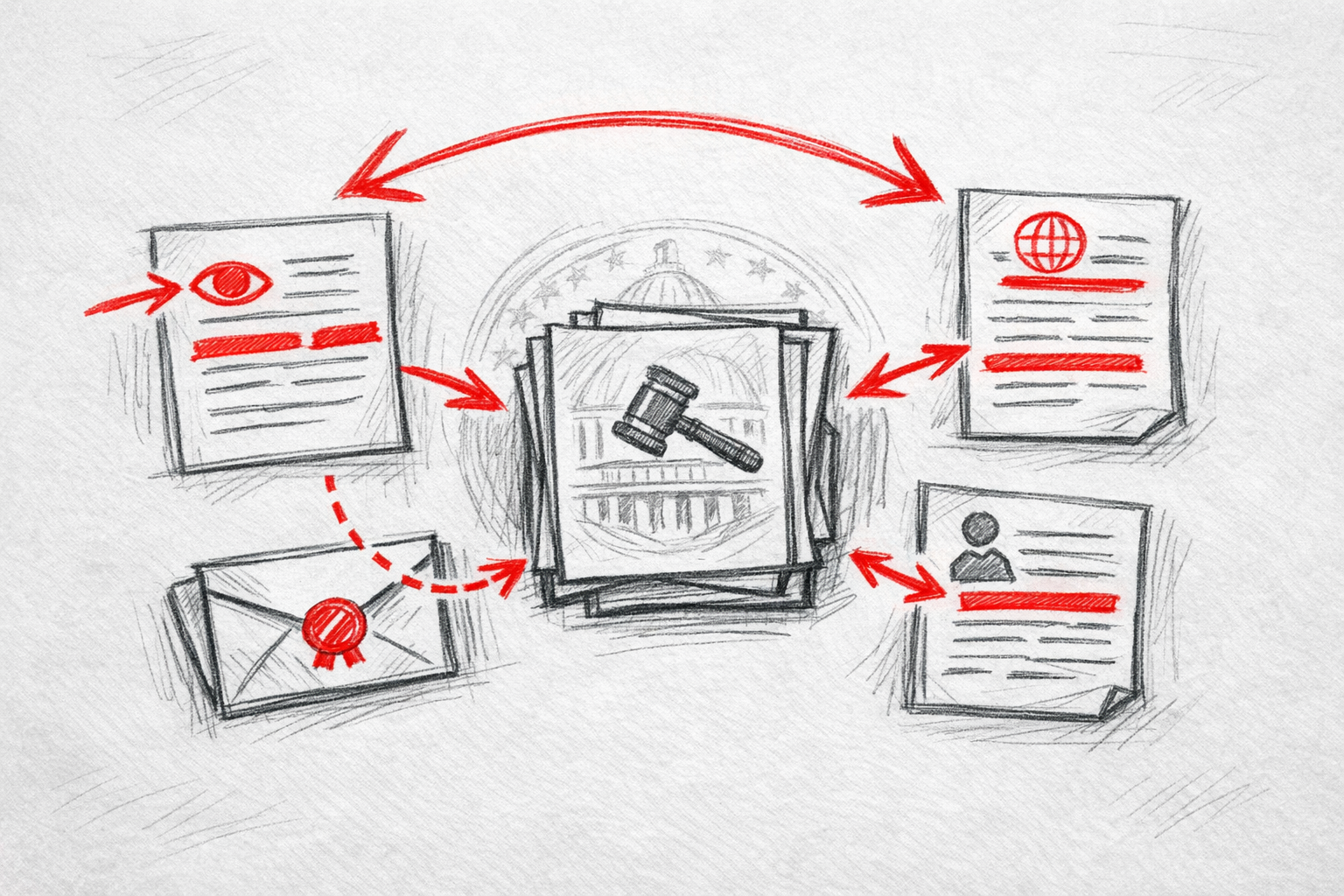
Three bills introduced in the US House of Representatives within days of each other in late March and early April 2026 share the word "transparency" in their titles - but address fundamentally different regulatory objectives. One targets the Department of Justice's handling of a sealed Special Counsel report; another would strengthen disclosure requirements under the Foreign Agents Registration Act (FARA); the third mandates real-time electronic notifications for immigration applicants. Taken together, the trio signals that "transparency" has become a versatile legislative vehicle in the 119th Congress, applied across national security, government accountability, and administrative process.
All three bills have been referred to the House Committee on the Judiciary. None has advanced beyond introduction.
| Bill | Sponsor(s) | Primary Target | Disclosure Mechanism | Committee |
|---|---|---|---|---|
| H.R. 8215 – Volume II Transparency Act | Rep. Cohen (D-TN), Rep. Menefee | Department of Justice | Mandatory publication of Special Counsel report on DOJ website within 7 days | Judiciary |
| H.R. 8155 – Foreign Propaganda Transparency Act | Rep. Stutzman (R), Reps. Fry, Roy, Moore (R-AL) | Foreign agents of covered nations (China, Russia, Iran, North Korea) | Amended FARA conspicuous statement on informational materials | Judiciary |
| H.R. 8191 – Immigration Status Notification and Transparency Act | Rep. Subramanyam (D), Rep. Moulton (D) | USCIS / immigration applicants | Electronic notification within 24 hours of status change via at least two channels | Judiciary |
Volume II Transparency Act: A Narrow but Politically Charged Demand
H.R. 8215, introduced on 9 April 2026 by Representative Steve Cohen (D-TN) and Representative Menefee, would direct the Attorney General to publish Volume II of Special Counsel Jack Smith's report on the Department of Justice website within seven days of enactment. [1]
Despite its broad-sounding name, the bill is surgically narrow in scope: it addresses a single sealed document. The report in question concerns the classified documents investigation, and a federal judge in Florida has prevented its public release. The bill frames disclosure as a matter of public accountability. For regulatory affairs professionals, the direct operational impact is limited - the bill does not create new compliance obligations for private sector entities. Its significance lies in the broader political signal: Congress asserting disclosure authority over executive branch investigative materials.
Foreign Propaganda Transparency Act: Hardening FARA Disclosures
H.R. 8155, introduced on 27 March 2026 by Representative Stutzman (R) with co-sponsors Fry, Roy, and Moore of Alabama, would amend Section 4(b) of the Foreign Agents Registration Act of 1938 (22 U.S.C. § 614(b)) to require that the conspicuous statement on informational materials also detail whether the foreign principal is supervised, directed, owned, controlled, financed, or subsidized by a "covered nation." [2]
The bill cross-references the definition of "covered nation" from 10 U.S.C. § 4872(d)(2) - a provision originally embedded in defence procurement law.
"Covered nations" under 10 U.S.C. § 4872(d)(2): The Foreign Propaganda Transparency Act borrows this definition from defense procurement law. It encompasses four states: the People's Republic of China, the Russian Federation, the Islamic Republic of Iran, and the Democratic People's Republic of North Korea. Any foreign agent acting on behalf of, or under the control of, entities linked to these nations would face enhanced disclosure requirements under the proposed bill.
This is not FARA's first legislative adjustment in recent years. In December 2024, the Department of Justice issued a Notice of Proposed Rulemaking (NPRM) proposing the first material revision of FARA's implementing regulations in nearly 30 years, including narrowing commercial activity exemptions and updating definitions. [3] H.R. 8155 would layer an additional requirement on top of existing FARA obligations by singling out relationships with adversarial states for mandatory, prominent disclosure on all informational materials disseminated by their agents.
For organisations registered under FARA - including lobbying firms, consultancies, media entities, and nonprofits with foreign government ties - the bill would impose a new due diligence obligation: determining and publicly disclosing whether a foreign principal has links to a covered nation. The practical challenge lies in the breadth of the operative language ("supervised, directed, owned, controlled, financed, or subsidized, in whole or in part"), which could capture indirect relationships requiring significant factual investigation.
Immigration Status Notification and Transparency Act: Real-Time Process Disclosure
H.R. 8191, introduced on 2 April 2026 by Representative Subramanyam (D) and Representative Moulton (D), would add a new Section 295 to the Immigration and Nationality Act requiring electronic notification within 24 hours of any change in status of an immigration petition or application. [4]
The notification must reach the applicant or petitioner, their legal representative, and each alien to whom the petition pertains, through at least two of three channels: email, phone call (including automated), or text message. [4]
Unlike the other two bills, this measure is not about compelling organisations to reveal information to the public. It is about compelling the government - specifically, US Citizenship and Immigration Services (USCIS) - to communicate proactively with affected individuals. The bill amends Chapter 9 of Title II of the Immigration and Nationality Act, adding the notification requirement as a new statutory provision rather than an administrative rule. [4] This distinction matters: codification would make the obligation harder to reverse through subsequent rulemaking.
For immigration law practitioners and employers sponsoring foreign workers, the bill would create a more predictable notification environment. Businesses relying on timely visa processing - particularly in technology, healthcare, and professional services - stand to benefit from faster, multi-channel status updates.
The Broader Context: Disclosure as a Legislative Default
The simultaneous appearance of these three bills reflects a pattern visible across both US and EU legislative agendas: transparency requirements are becoming a default mechanism for addressing accountability gaps, national security concerns, and administrative efficiency.
In the EU, the trend manifests differently but in parallel. The Corporate Sustainability Reporting Directive (CSRD), even after the scope reduction introduced by Directive (EU) 2026/470's Omnibus I amendments in February 2026, continues to impose significant disclosure obligations on large companies. Directive (EU) 2026/470, published on 26 February 2026, substantially raised the thresholds for CSRD applicability but maintained the framework's core transparency architecture for the largest companies. [5] The EU's approach embeds disclosure within a regulatory compliance structure backed by enforcement mechanisms - a contrast with the US bills examined here, which remain at the proposal stage and face uncertain legislative prospects.
What to Watch
None of these three bills has advanced to markup. Given the divided political dynamics of the 119th Congress, passage is far from certain for any of them. However, each illuminates a live policy vector:
- FARA-registered entities should monitor H.R. 8155 alongside the DOJ's pending NPRM on FARA regulations. If both advance, the cumulative disclosure burden could increase substantially.
- Immigration employers and counsel should track H.R. 8191 for potential impacts on case management workflows and client communication protocols.
- Compliance teams broadly should note the legislative tendency to codify notification and disclosure obligations that were previously discretionary or governed by agency practice - a trend that, once enacted, constrains future administrative flexibility.
Bild: Gabriel Cox / Unsplash
- H.R. 8215 — Volume II Transparency Act of 2026
- H.R. 8155 — Foreign Propaganda Transparency Act
- DOJ Proposes Significant Changes to FARA's Regulations (NPRM, December 2024)
- H.R. 8191 — Immigration Status Notification and Transparency Act of 2026
- Directive (EU) 2026/470 — Omnibus I amendments to CSRD and CS3D